
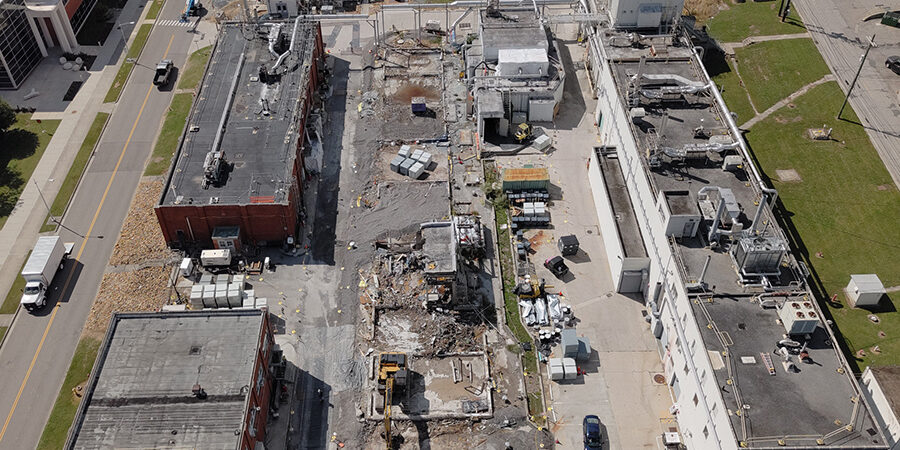
A series of 10 highly contaminated buildings at Oak Ridge National Laboratory has been demolished, concluding a six-year project that has eliminated legacy hazards.
Crews demolished these former radioisotope production facilities, known collectively as Isotope Row, in only two months. This major accomplishment is helping transform the heart of the laboratory’s central campus and creates new opportunities for future research missions.
Multi-disciplined personnel completed a multitude of task over the six-year span, including the removal of nearly 3 million pounds of waste, six hot cells, four 2,000-pound krypton tanks, contaminated glove boxes, and ventilation systems as part of this project. They also demolished over 12,000-square-feet of buildings, all while performing more than 375,000 work hours safely. Most demolition debris was disposed of onsite, avoiding transportation costs and allowing OREM to use taxpayer dollars responsibly while accelerating cleanup.
The magnitude of this accomplishment becomes clearer when considering what these facilities once housed — and what was left behind.
Constructed between the late 1940s and early 1960s, Isotope Row supported radioisotope production and research for medical, industrial, scientific, and national defense applications. When operations ended in the early 1990s, the buildings remained, along with highly contaminated hot cells, glove boxes, radioactive isotopes, mercury, asbestos, and hazardous process systems that would require decades of planning and specialized cleanup approaches.
UCOR began deactivation in 2020, first isolating utilities and removing combustible materials, hazardous waste, and asbestos before tackling heavily contaminated process equipment and ventilation systems. Partnerships were equally critical to the success of this project. OREM, UCOR, UT-Battelle (ORNL’s prime contractor), and DOE’s Office of Science worked together to support the facilities’ transition to cold-and-dark status. Working closely with UT-Battelle, crews strategically scheduled teardowns during afternoon hours to minimize impacts to active laboratory missions.
During demolition, crews strategically left Building 3033 until last because of elevated tritium—a highly radioactive contaminant, and other contaminants. This sequencing minimized the potential for cross-contamination of surrounding debris, which could have changed waste disposal requirements, increased costs, and prolonged demolition.
After decades standing at the heart of ORNL, Isotope Row is gone and ORNL’s skyline is forever changed, clearing the way for its next generation of scientific discovery.
Isotope Row before and after demolition